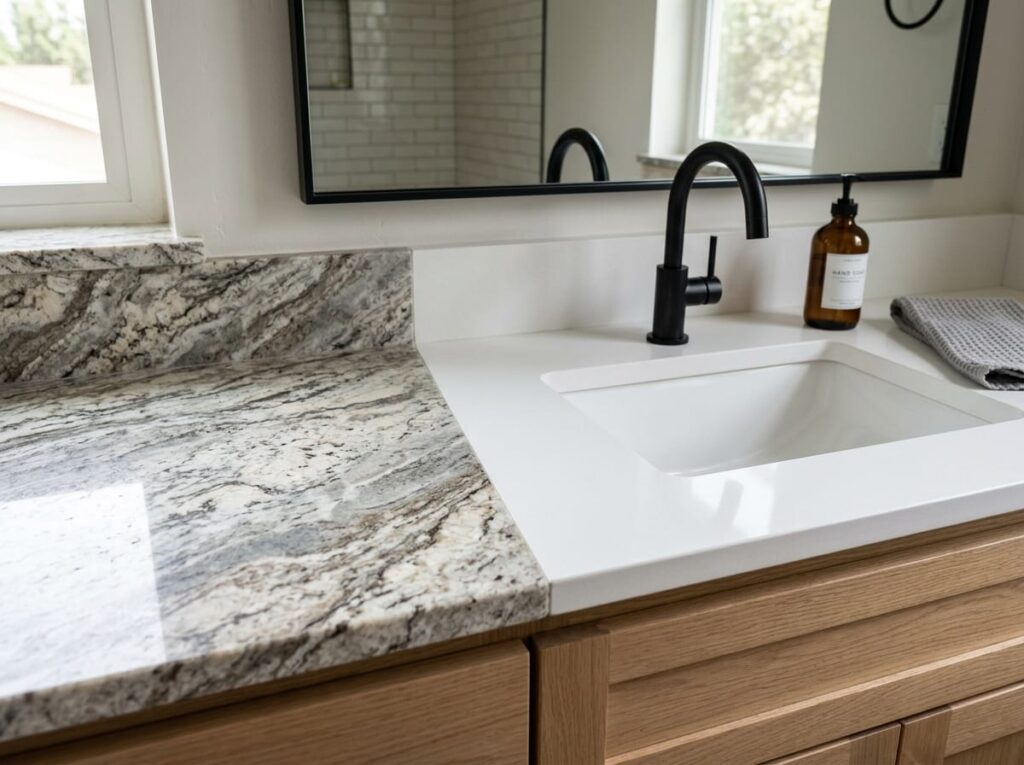
Neither granite nor quartz is universally better. Quartz is engineered, nonporous, and the lower-maintenance choice that never needs sealing, which makes it the most popular pick for bathroom vanities today. Granite is natural stone, so every slab is one of a kind, but it needs periodic sealing. For most Fort Collins bathrooms we work on, quartz wins on convenience and granite wins when you want a true natural-stone look.
If the vanity is part of a larger project, our bathroom addition cost guide covers the full-room numbers.
| Granite | Quartz | |
|---|---|---|
| Installed cost | $40–$100+ per sq ft | $40–$100+ per sq ft |
| Sealing | At install, then periodically | Never |
| Stain resistance | Porous, needs sealing to resist stains | Nonporous, stain-resistant |
| Look | Natural, one-of-a-kind slab | Engineered, consistent pattern |
| Lifespan | Decades with care | Decades, less upkeep |



 Trustindex verifies that the original source of the review is Google.
 Trustindex verifies that the original source of the review is Google.
 Trustindex verifies that the original source of the review is Google.
 Trustindex verifies that the original source of the review is Google.
 Trustindex verifies that the original source of the review is Google.
 Trustindex verifies that the original source of the review is Google.
 Trustindex verifies that the original source of the review is Google.
 Trustindex verifies that the original source of the review is Google.
 Trustindex verifies that the original source of the review is Google.
Not universally. Granite gives you a natural, one-of-a-kind look; quartz is better for low maintenance and stain resistance because it is nonporous and never needs sealing. For a bathroom vanity, most homeowners choose quartz for the convenience.
Both last decades when installed and cared for properly. Quartz keeps its finish with less upkeep because it does not need sealing; granite needs periodic resealing to stay stain-resistant.
Both granite and quartz vanity tops commonly run $40 to $100+ per square foot installed, depending on the slab, color and thickness rather than the material category alone. Quartz often sits slightly higher upfront but never needs sealing. We give you real, current quotes for your specific project.
Quartz is the most popular vanity choice because it is nonporous and shrugs off water, toothpaste and cosmetics without sealing. Granite works beautifully too if you want natural stone.
Granite needs sealing, typically when installed and periodically after. Quartz never needs sealing because it is nonporous.